Shipping Drones from China Internationally (2026 Guide)
Quick Answer
To ship drones from China internationally:
- Check if the drone is export-controlled
- Provide an End-User Statement (if required)
- Verify import regulations in your country
- Prepare customs and battery documents
👉 Missing any of these can result in shipment delays, seizure, or rejection
Does Your Drone Require Export Approval?
Your drone is likely controlled for export if it meets ANY of the following:
- Flight time ≥ 30 minutes OR weight ≥ 7 kg
- Speed ≥ 100 km/h OR range ≥ 300 km
- Equipped with surveillance (e.g., infrared, night vision)
- Payload ≥ 20L OR engine power ≥ 16 kW
👉 If YES → You must provide an End-User Statement (EUS)
👉 If NO → Standard shipping process applies
What Buyers Must Do (Critical Responsibilities)
As the buyer, you are responsible for:
- Providing an End-User Statement (if required)
- Confirming drone import regulations in your country
- Handling customs clearance at destination
- Checking lithium battery import restrictions
👉 These directly determine whether your shipment clears customs
Required Documents for Drone Shipping
Prepare the following:
- Commercial invoice & packing list
- Purchase contract
- CE / FCC certifications (depending on country)
- End-User Statement (if required)
- Battery documents (UN38.3, MSDS)
Lithium Battery Rules (Common Failure Point)
Drones contain lithium batteries (Class 9 dangerous goods).
You must confirm:
- Whether your country restricts battery capacity (e.g., >100Wh)
- That UN38.3 and MSDS documents are available
👉 Battery non-compliance is a common reason for customs delays
Most Common Reasons Drone Shipments Fail
- Missing or incorrect End-User Statement
- Import restrictions not checked in advance
- Incomplete certification (CE, FCC, etc.)
- Battery compliance issues
Key Risks to Be Aware Of
If compliance is not met:
- Shipment may be held or seized
- Additional costs (storage, return, destruction)
- Import restrictions or blacklisting
Final Conclusion
To ship drones from China successfully:
- Confirm if export approval is required
- Provide accurate End-User documentation
- Verify import and battery regulations
- Ensure all documents are complete
👉 Following these steps prevents most shipping issues
FAQ: Shipping Drones from China Internationally
1. Can drones be shipped internationally from China?
Yes, drones can be shipped internationally from China, but some models are subject to export control regulations.
If the drone meets certain technical thresholds (such as flight time, payload, or surveillance capability), the exporter must apply for a license, and the buyer must provide an End-User Statement.
👉 Most consumer drones can be shipped without special approval, but industrial or high-performance drones often require compliance review.
2. Do I need a license to import drones from China?
In most cases, the exporter (Chinese supplier) handles export licensing.
However, as the buyer, you may need to:
- Provide an End-User Statement
- Register the drone with local authorities (e.g., FAA in the United States)
- Ensure the product meets local certification requirements (CE, FCC, etc.)
👉 Import requirements depend on your country.
3. Why are drone shipments often delayed or seized?
The most common reasons include:
- Missing or incorrect End-User Statement
- Failure to comply with export control regulations
- Incomplete certifications (CE, FCC)
- Lithium battery compliance issues
- Import restrictions not checked in advance
👉 Most issues are preventable with proper documentation.
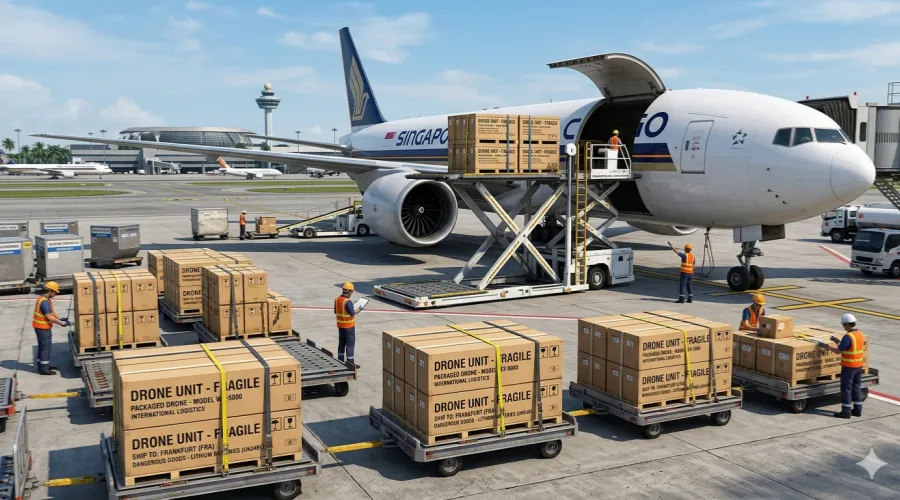
4. Can drones with batteries be shipped by air?
Yes, but drones with lithium batteries are classified as dangerous goods (Class 9).
They can be shipped by air if:
- Batteries meet UN38.3 testing requirements
- Proper packaging and labeling are used
- Airline regulations are followed
👉 Some airlines or countries may restrict high-capacity batteries.
5. What documents are required to ship drones internationally?
Typical required documents include:
- Commercial invoice and packing list
- Purchase contract
- CE / FCC certifications (depending on destination)
- End-User Statement (if required)
- Battery documents (UN38.3, MSDS)
👉 Missing documents are a leading cause of delays.
6. Are Chinese drones banned in the United States or Europe?
Not entirely, but restrictions exist.
- In the United States, some Chinese drone brands are affected by regulatory and security restrictions
- In the EU, drones must comply with CE certification and registration rules
👉 Always verify the latest import regulations before shipping.
7. How much does it cost to ship drones from China?
Shipping costs depend on:
- Shipping method (air, sea, express)
- Battery type and capacity
- Weight and dimensions
- Destination country
👉 Air freight is faster but more expensive; sea freight is cheaper for bulk shipments.
8. Do I need to pay import duties on drones?
Yes, most countries impose:
- Import duties
- VAT or GST
The exact cost depends on:
- HS code classification
- Country-specific tariff policies
👉 Check local customs regulations for accurate rates.
9. Can I ship drones via DHL, FedEx, or UPS?
Yes, but only under certain conditions:
- The drone must comply with battery shipping regulations
- Some carriers restrict or require special approval for drones
- High-value or controlled drones are often better handled by freight forwarders
👉 Courier is suitable for small shipments; freight forwarders are better for bulk or controlled cargo.
10. What is an End-User Statement and why is it required?
An End-User Statement (EUS) is a document provided by the buyer that confirms:
- The drone’s intended use
- The final user
- The location of use
It is required for export-controlled drones to ensure they are not used for military or restricted purposes.
👉 Without it, shipments may be denied export.
Related Resources