How to Export E-Cigarettes from China (2026 Shipping & Compliance Guide)
Foreword
China remains the global manufacturing center for electronic cigarettes, producing more than 90% of the world's vape products, with Shenzhen serving as the core industry hub. As global regulations tighten in 2026, exporting e-cigarettes now requires strict compliance with dangerous goods transport rules, lithium battery safety standards, and destination market certifications.
Exporters must prepare documents such as UN38.3 battery test reports, MSDS, and Dangerous Goods Identification Reports (DGM) before arranging shipments. Most vape products are transported via air freight as Class 9 dangerous goods, requiring specialized packaging and certified logistics providers.
This guide explains the complete process of exporting e-cigarettes from China, including compliance requirements, shipping methods, packaging standards, customs clearance, and common risks.
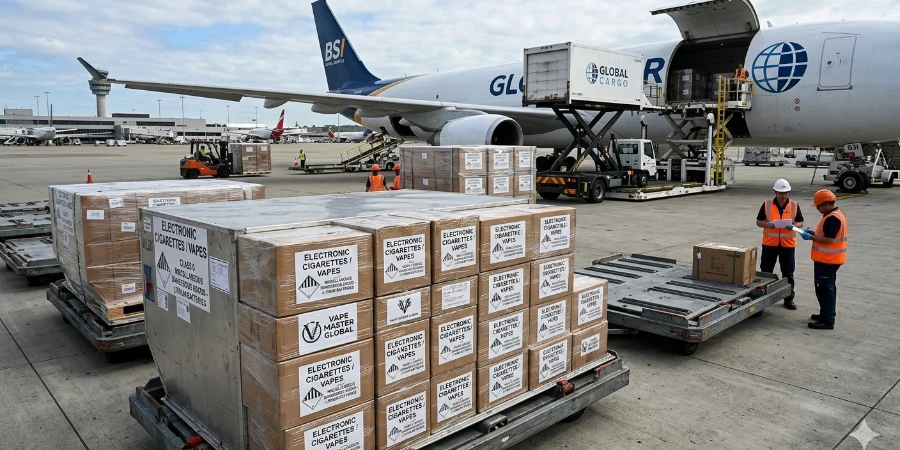
Table of Contents
- Why China Dominates Global E-Cigarette Manufacturing
- Can E-Cigarettes Be Shipped Internationally?
- Pre-Export Compliance Requirements (2026 Regulations)
- Step-by-Step E-Cigarette Export Process
- Shipping Methods for E-Cigarettes from China
- E-Cigarette Shipping Cost from China
- Packaging & Dangerous Goods Regulations
- Customs Clearance for Vape Exports
- Common Risks When Exporting E-Cigarettes
- Why Choose a Professional Vape Logistics Partner
- FAQ: Exporting E-Cigarettes from China
Why China Dominates Global E-Cigarette Manufacturing
China has developed the world's largest e-cigarette manufacturing ecosystem, supplying products to markets across North America, Europe, the Middle East, and Southeast Asia.
Several factors contribute to China’s dominance:
- Highly integrated manufacturing supply chains
- Advanced lithium battery production capabilities
- Large-scale OEM and ODM manufacturing services
- Competitive export logistics infrastructure
However, despite the large export volume, e-cigarette shipping involves strict international compliance requirements because the products often contain both lithium batteries and nicotine liquids.
Can E-Cigarettes Be Shipped Internationally?
Yes, e-cigarettes can be shipped internationally. However, they are usually classified as dangerous goods for air transportation due to the presence of lithium batteries and e-liquid components.
To ship e-cigarettes from China, exporters must typically prepare:
- UN38.3 lithium battery safety test report
- MSDS (Material Safety Data Sheet)
- Dangerous Goods Identification Report (DGM)
- Commercial invoice and packing list
- Export manufacturing certification
Without these documents, airlines and customs authorities may reject the shipment.
Pre-Export Compliance Requirements (2026 Regulations)
Before exporting e-cigarettes, businesses must ensure they meet both Chinese regulatory requirements and destination market standards.
1. Export Business Qualifications
Exporters must have:
- Valid export manufacturing license
- Import and export business registration
- Approved production capacity authorization
Products shipped beyond authorized capacity may be rejected by regulatory authorities.
2. Required Product Compliance Documents
Several documents are required to prove the safety and legality of vape products in international transportation.
Key documents include:
Dangerous Goods Identification Report (DGM)
Required for devices containing lithium batteries or e-liquid.
UN38.3 Lithium Battery Test Report
Confirms that batteries meet international air transport safety standards.
MSDS (Material Safety Data Sheet)
Provides detailed information about chemical composition and handling procedures.
Destination Market Certification
Examples include:
- EU TPD certification
- US PMTA authorization
- UK UKCA compliance
Failure to provide valid documentation may result in cargo detention, shipment rejection, or regulatory penalties.
Step-by-Step E-Cigarette Export Process
Exporting vape products from China typically follows a six-step logistics workflow.
Step 1 – Order Confirmation
The export process begins with confirming:
- product model and specifications
- order quantity
- delivery terms (DAP / DDP)
- compliance responsibilities
- payment conditions
A compliance check should be conducted before production begins.
Step 2 – Production and Packaging
Manufacturing must remain within the approved production capacity.
Different product categories require specific packaging standards.
Examples include:
- Disposable vapes must remain fully assembled and sealed
- Battery devices require short-circuit protection packaging
- E-liquid products must be leak-proof sealed
Step 3 – Dangerous Goods Declaration
Because most vape products contain lithium batteries, they are classified as Class 9 dangerous goods for air freight.
Exporters must submit:
- DGM report
- UN38.3 test report
- MSDS documentation
- product photos
- packing list
All documentation must match the actual shipment.
Step 4 – Customs Declaration
During export declaration, customs authorities review the shipment classification and documentation.
Common HS codes include:
| Product Type | HS Code |
|---|---|
| Finished e-cigarette | 8543400000 |
| Disposable vape | 2404120000 |
| Accessories | 8543909000 |
Required customs documents typically include:
- commercial invoice
- packing list
- export contract
- product compliance certificates
Step 5 – Export Filing
Exporters must complete regulatory filing within 30 days after customs clearance.
All documents and records should be retained for at least three years for compliance audits.
Step 6 – Destination Customs Clearance and Delivery
At the destination country, shipments must pass:
- import customs declaration
- regulatory inspection
- duty and tax payment
- final delivery to consignee
Many exporters choose DAP or DDP delivery terms to simplify cross-border trade.
Shipping Methods for E-Cigarettes from China
Several shipping options are available depending on shipment size, cost considerations, and delivery urgency.
1. Air Freight
Air freight is the most commonly used method for e-cigarette exports.
Advantages include:
- fast delivery time
- stable international airline routes
- suitable for high-value cargo
Typical transit time: 3–7 days
2. Sea Freight
Sea freight is often used for bulk shipments.
Advantages include:
- lower cost for large cargo volumes
- suitable for containerized shipments
Typical transit time: 25–40 days
However, sea freight also requires strict dangerous goods documentation.
E-Cigarette Shipping Cost from China
Shipping cost varies depending on shipment weight, shipping method, and destination.
Typical international freight ranges are shown below.
| Shipping Method | Cost Range | Transit Time |
|---|---|---|
| Air Freight | $6 – $12 per kg | 3 – 7 days |
| Sea Freight | $1.5 – $3 per kg | 25 – 40 days |
| Express Courier | $12 – $20 per kg | 3 – 5 days |
Actual shipping cost may vary depending on:
- dangerous goods handling fees
- lithium battery classification
- airport security inspections
- destination customs duties
Packaging & Dangerous Goods Regulations
Proper packaging is essential to ensure safe transport and airline acceptance.
Export cartons must include:
- lithium battery hazard labels
- emergency contact information
- product batch number
- carton number and weight
- "For Export Only" marking
Lithium battery labels must meet the 10 × 10 cm international labeling standard.
Improper labeling may lead to airline cargo rejection or customs inspection delays.
Customs Clearance for Vape Exports
Successful customs clearance depends on three critical factors:
1️⃣ Accurate HS code classification
2️⃣ Complete documentation
3️⃣ Proper packaging and labeling
Many exporters choose to work with experienced freight forwarders to ensure compliance with both Chinese customs regulations and destination import requirements.
Common Risks When Exporting E-Cigarettes
Despite strong global demand, vape exports involve several compliance risks.
Common issues include:
Uncertified exports
Shipments without valid manufacturing certification may be seized by authorities.
Incorrect lithium battery labeling
Improper packaging or labeling may cause airlines to reject the cargo.
Document inconsistencies
Differences between shipping documents and physical goods may trigger customs inspection.
Missing export filing
Failure to complete regulatory filing may lead to penalties or export restrictions.
Proper compliance preparation can significantly reduce these risks.
Why Choose a Professional Vape Logistics Partner
Due to the complex regulatory environment, many exporters rely on professional logistics providers.
An experienced freight forwarder can assist with:
- dangerous goods shipping documentation
- lithium battery transport compliance
- airline cargo space booking
- customs clearance coordination
- global door-to-door delivery
Professional logistics support helps exporters reduce operational risks and improve international shipping efficiency.
Ship E-Cigarettes from China Safely
If you need professional support for exporting vape products internationally, **BSI Global Logistics provides specialized dangerous goods shipping solutions.
Our services include:
- Dangerous goods documentation support
- UN38.3 and MSDS compliance guidance
- stable international air freight routes
- customs clearance coordination
- global DAP/DDP door-to-door delivery
Contact our logistics experts today to receive a customized shipping solution.
FAQ: Exporting E-Cigarettes from China
Can e-cigarettes be shipped internationally?
Yes. However, most e-cigarettes contain lithium batteries and e-liquid, which classify them as dangerous goods for air transport. Proper documentation and packaging are required.
What documents are required to export e-cigarettes from China?
Typical documents include UN38.3 battery test reports, MSDS documentation, Dangerous Goods Identification Reports, commercial invoices, packing lists, and export certification.
What is the best shipping method for e-cigarettes?
Air freight is usually the preferred shipping method because it offers faster transit times and more stable global logistics routes.
How long does international vape shipping take?
Air freight shipments typically take 3–7 days, while sea freight shipments may take 25–40 days depending on the destination.
Can freight forwarders help with vape shipping compliance?
Yes. Experienced freight forwarders can assist with dangerous goods declarations, documentation preparation, customs clearance, and international delivery.
Related Logistics Guides
You may also find these logistics guides helpful:
- DDP vs DAP: Cost Comparison and Real Shipping Examples
- Dangerous Goods Air Freight Guide
- Shipping from China to Europe
- Shipping Electronics from China
Related Resources