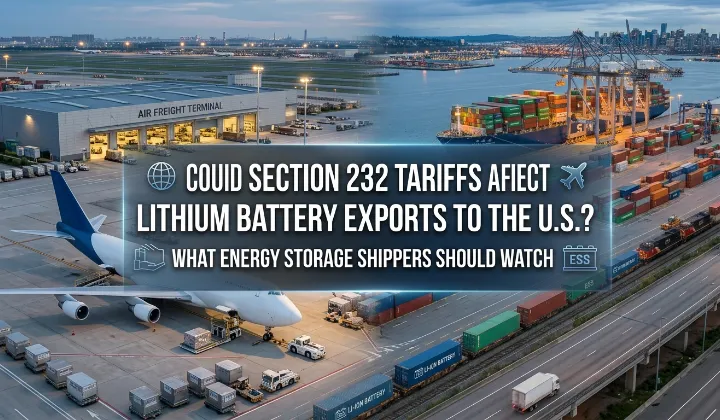
Could Section 232 Tariffs Affect Lithium Battery Exports to the U.S.? What Energy Storage Shippers Should Watch
Recent U.S. trade policy developments have brought renewed attention to Section 232 tariffs, particularly after the United States announced new tariffs on imported drones and certain drone components. For companies exporting LFP lithium batteries, home energy storage systems, and commercial & industrial (C&I) ESS products, the more important question is:
Could lithium batteries and energy storage products become part of future Section 232 actions?
At the moment, the U.S. has not broadly imposed Section 232 tariffs on lithium battery products. However, energy storage systems, grid-related equipment, battery manufacturing, and other strategic technologies are increasingly being discussed within the broader framework of U.S. supply chain security and national security policy.
Quick navigation
- What are Section 232 tariffs?
- Why energy storage exporters should pay attention
- Four logistics areas that could be affected
- How BSI helps prepare for potential policy changes
- FAQ
What are Section 232 tariffs?
Section 232 tariffs are trade measures imposed under Section 232 of the U.S. Trade Expansion Act of 1962. The law allows the U.S. government to investigate whether imports of certain products threaten national security and, if necessary, impose tariffs or other import restrictions.
Unlike ordinary customs duties, Section 232 actions are typically aimed at strategic industries and critical supply chains, such as steel, aluminum, automotive products, semiconductors, and more recently, certain drone products and components.
Companies shipping batteries and energy storage equipment to the United States should evaluate both tariff exposure and transportation planning through a reliable China to USA air freight services partner.
Why energy storage exporters should pay attention
Although lithium batteries are not currently subject to broad Section 232 tariffs, the policy trend is important. Products related to energy infrastructure, grid resilience, advanced manufacturing, batteries, and critical technologies are receiving increased regulatory attention in the United States.
For exporters of LFP batteries, residential ESS systems, C&I energy storage solutions, portable power stations, and battery modules, future policy changes could affect more than just tariff rates.
Potential impacts may include:
- More stringent U.S. customs inspections
- Tighter origin verification requirements
- Greater scrutiny of battery components and supply chains
- Increased demand for U.S. inventory and overseas warehousing
For project-based energy storage shipments, delivery timing and compliance risk often matter more than freight rates alone.
Four logistics areas that could be affected
1. Customs clearance and product classification
U.S. Customs may place greater emphasis on:
- HS classification accuracy
- Product specifications
- Battery chemistry
- Manufacturer identification
- Component origin
- End-use declarations
For lithium battery products, proper dangerous goods documentation and classification remain essential.
2. Overseas warehousing and inventory planning
U.S. importers may increase safety stock and local warehouse inventory to reduce exposure to future policy changes.
This can create additional demand for:
- U.S. overseas warehouses
- Bonded storage
- Inventory replenishment programs
- Regional distribution networks
3. Supply chain restructuring
Some manufacturers may consider:
- Third-country assembly
- Regional manufacturing
- Component diversification
- Alternative sourcing strategies
This does not eliminate compliance requirements, but it can change transportation routes and logistics planning.
4. Project delivery risk
Large ESS projects typically operate on fixed installation schedules. Any disruption in transportation, customs clearance, documentation review, or warehouse coordination can affect the entire project timeline.
For utility-scale and C&I shipments, advanced logistics planning becomes increasingly important.
How BSI helps prepare for potential policy changes
For companies currently shipping energy storage products to the United States, BSI recommends focusing on four areas:
- Verify HS codes and origin information before shipment
- Prepare UN38.3, MSDS, dangerous goods packaging, and compliance documents in advance
- Allow additional lead time for U.S. customs and project-based deliveries
- Evaluate U.S. overseas warehouse or regional inventory strategies when appropriate
BSI has extensive experience handling LFP lithium batteries, residential ESS systems, C&I storage equipment, and dangerous goods shipments for the U.S. market. Our services cover DG compliance, booking, export customs, international transportation, U.S. customs coordination, and final-mile delivery.
FAQ
Q: Are LFP lithium batteries currently subject to broad Section 232 tariffs?
A: As of now, the United States has not broadly imposed Section 232 tariffs on LFP lithium battery products. The main concern is the future policy direction and whether additional energy-related products may be included in national security-based trade measures.
Q: What is the biggest logistics risk if Section 232 expands?
A: The largest risk is usually customs compliance and delivery uncertainty, including product classification, origin verification, documentation review, and project scheduling.
Q: What documents should battery exporters prepare now?
A: Exporters should prepare UN38.3 test reports, MSDS, dangerous goods packaging documentation, product specifications, HS code information, and origin-related documents before shipment.
Q: Will U.S. overseas warehousing become more important?
Yes. If regulatory scrutiny increases, maintaining local inventory and warehouse capacity in the United States can help reduce delivery risk and improve supply chain flexibility.
Key takeaway
The recent drone-related tariff announcement should be viewed primarily as a policy signal rather than a direct lithium battery measure. For the energy storage industry, the more important trend is the growing focus on strategic technologies, critical supply chains, and energy infrastructure within U.S. trade policy.
Companies exporting LFP batteries and energy storage systems to the United States should not assume that future policy changes will affect only tariff rates. Compliance preparation, customs documentation, inventory planning, and logistics flexibility may become increasingly important competitive advantages.
If you are shipping LFP batteries, home energy storage systems, C&I ESS equipment, or other battery-related products to the U.S., BSI can help evaluate the most suitable logistics and compliance strategy for your shipments.
Related Resources