Shipping from China to Korea (South Korea) 2026: Air & Sea Freight Guide
China and South Korea maintain one of the busiest trade corridors in Asia. High-value industries such as electronics, semiconductors, automotive components, fashion retail, and cross-border e-commerce rely heavily on fast and reliable logistics between the two countries.
Because of the short geographic distance and dense flight schedules, shipping from China to Korea offers fast transit times and flexible logistics options for importers and exporters.
BSI Global Logistics provides professional air freight, ocean freight, and door-to-door shipping services connecting major Chinese cities with South Korea’s primary logistics hubs.
Whether you need urgent air cargo or cost-efficient sea freight, our logistics solutions are designed to ensure speed, compliance, and cost efficiency.
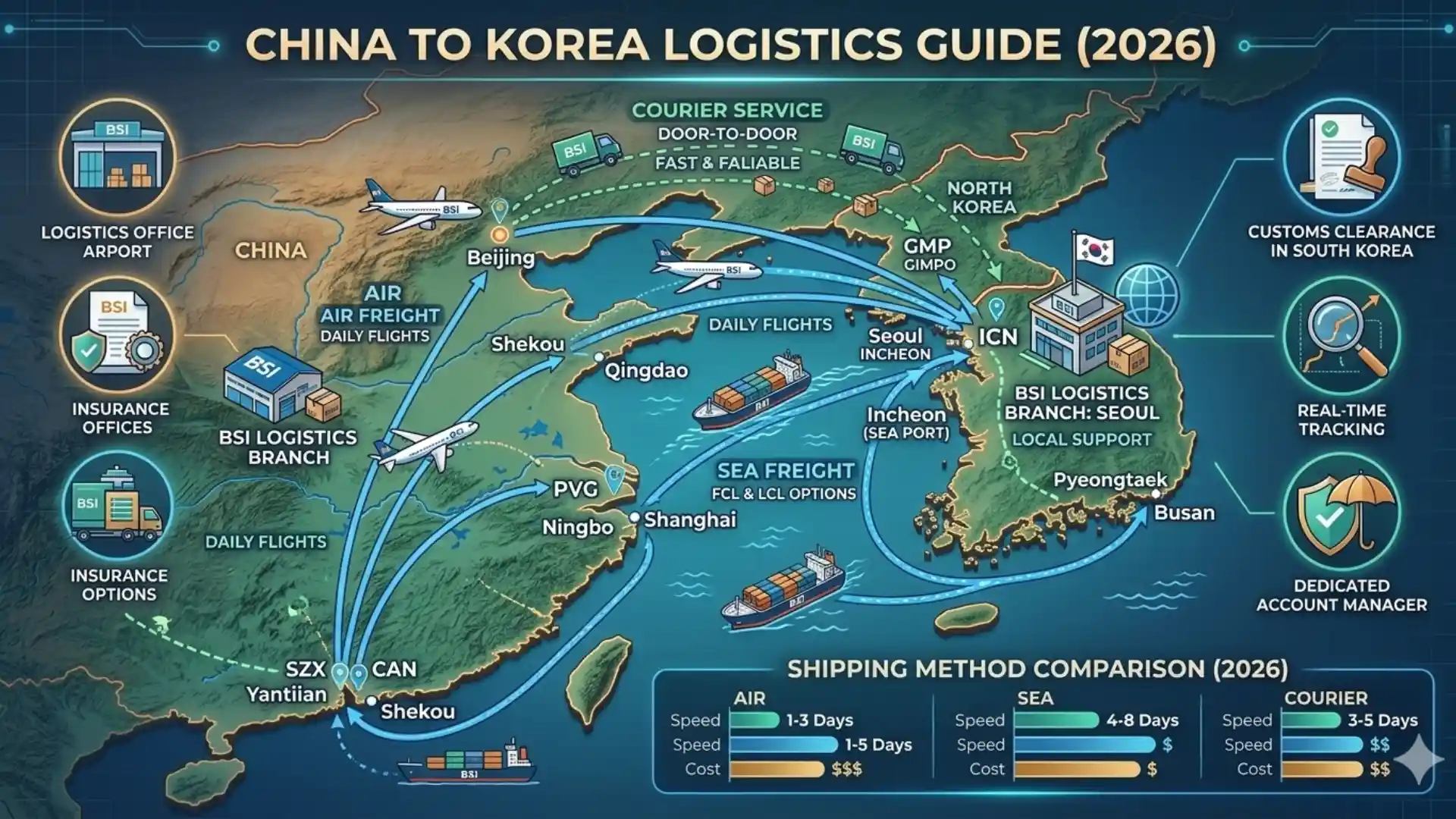
1. China to Korea Air Freight
Air freight is the fastest shipping method from China to South Korea, typically delivering cargo within 1–3 days depending on the origin city and flight schedule.
Air freight is ideal for:
- Electronics
- Semiconductor components
- Automotive parts
- Medical devices
- High-value cargo
- Urgent e-commerce inventory
Through partnerships with leading airlines, BSI Global Logistics offers stable cargo space and frequent departures to Seoul Incheon (ICN).
2 . Major Air Routes from China to Korea
The following are key air cargo routes connecting China and South Korea.
| Destination | Origin | Airline | Frequency | Route | Aircraft |
|---|---|---|---|---|---|
| Seoul ICN | Guangzhou | Korean Air | Daily | CAN-ICN | B777F |
| Seoul ICN | Guangzhou | Jin Air | D245 | CAN-ICN | B747F |
| Seoul ICN | Guangzhou | China Southern | Daily | CAN-ICN | A320 |
| Seoul ICN | Guangzhou | Asiana Airlines | Daily×2 | CAN-ICN | A333 |
| Seoul ICN | Shenzhen | Shenzhen Airlines | Daily×2 | SZX-ICN | A320 |
| Seoul ICN | Shenzhen | UPS Airlines | D2345 | SZX-ICN | B767F |
| Seoul ICN | Shenzhen | China Southern | Daily | SZX-ICN | A320 |
| Seoul ICN | Shenzhen | Asiana Airlines | Daily | SZX-ICN | A333 |
| Seoul ICN | Shanghai | Asiana Airlines | Daily | PVG-ICN | B747 |
| Seoul ICN | Wenzhou | YTO Airlines | D123456 | WNZ-ICN | B757F |
| Seoul ICN | Zhengzhou | SF Airlines | D23457 | EHU-ICN | B738F |
| Seoul ICN | Nantong | JD Airlines | D47 | NTG-ICN | B738F |
| Seoul ICN | Chengdu | Jin Air | D3567 | CTU-ICN | B738F |
| Seoul ICN | Zhengzhou | GP Cargo | D37 | CGO-ICN | B738F |
| Seoul ICN | Changsha | China Southern | D26 | CSX-ICN | A320 |
| Seoul ICN | Changsha | Korean Air | D13457 | CSX-ICN | A320 |
| Seoul ICN | Changsha | Asiana Airlines | D1256 | CSX-ICN | A320 |
| Seoul ICN | Wuhan | Korean Air | D23457 | WUH-ICN | B777 |
These routes provide high-frequency air cargo capacity between China and Korea, ensuring stable logistics operations for businesses.
3. China to Korea Sea Freight
For larger shipments and cost-sensitive cargo, sea freight from China to Korea offers a highly economical option.
Common shipping methods include:
FCL – Full Container Load
Suitable for large shipments such as:
- Industrial machinery
- Manufacturing materials
- Bulk consumer goods
LCL – Less than Container Load
Suitable for:
- Small and medium businesses
- Consolidated shipments from multiple suppliers
4. Major Ocean Freight Routes
Key shipping routes include:
Chinese Ports
- Shanghai
- Ningbo
- Shenzhen
- Qingdao
- Guangzhou
- Tianjin
South Korean Ports
- Busan
- Incheon
- Gwangyang
Typical sea freight transit time: 3–7 days
5. Door-to-Door Shipping from China to Korea
BSI Global Logistics offers complete door-to-door shipping services, including:
- Factory pickup in China
- Export customs clearance
- International transportation
- Import customs clearance in Korea
- Final delivery
Available shipping terms include:
- DAP (Delivered at Place)
- DDP (Delivered Duty Paid)
This service is particularly beneficial for companies unfamiliar with Korean customs procedures.
6. Shipping Cost Structure
Shipping costs from China to Korea depend on several factors.
Air freight costs typically include:
- Air freight rate
- Fuel surcharge
- Security surcharge
- Handling fees
- Customs clearance
Sea freight costs may include:
- Ocean freight
- Terminal handling charges
- Documentation fees
- Customs clearance
- Inland trucking
Final shipping costs depend on:
- Cargo weight or volume
- Transport method
- Seasonality
- Delivery terms (DAP / DDP)
7. Korea Import Customs & Regulations
Importing goods into South Korea requires proper documentation and compliance with customs regulations.
Common required documents include:
- Commercial Invoice
- Packing List
- Bill of Lading or Air Waybill
- Import Declaration
- HS Code classification
Certain products may require additional certification, including:
- KC certification for electronics
- Food safety approvals
- Medical device regulations
Customs clearance in Korea is generally efficient and typically completed within 1–2 business days if documents are accurate.
8. Industries We Serve
BSI Global Logistics supports various industries shipping between China and South Korea:
- Electronics and semiconductors
- Automotive components
- Retail and fashion
- Healthcare and pharmaceuticals
- Cross-border e-commerce
- Industrial equipment
9. Why Choose BSI Global Logistics
Businesses choose BSI Global Logistics for China-Korea shipping because of:
- Stable airline cargo capacity
- Multiple departure cities across China
- Competitive sea freight solutions
- Professional customs clearance support
- Flexible door-to-door logistics services
- Dedicated customer support
Our mission is to help companies build efficient, reliable, and scalable supply chains between China and South Korea.
10. China to Korea Shipping – FAQ (Frequently Asked Questions)
1. How long does shipping from China to Korea take?
Transit time depends on the shipping method.
- Air Freight: 1–3 days
- Sea Freight: 3–7 days
- Door-to-Door Delivery: usually 3–8 days depending on the origin city.
Air freight is typically used for urgent shipments, while sea freight is more cost-effective for bulk cargo.
2. What is the cheapest shipping method from China to Korea?
The most economical option is usually sea freight (LCL or FCL).
- LCL (Less than Container Load): best for small shipments
- FCL (Full Container Load): best for large cargo volumes
Sea freight costs are significantly lower than air freight, especially for heavy or bulky goods.
3. Which airports are commonly used for air freight to Korea?
The main air cargo hub in South Korea is Incheon International Airport (ICN).
Common departure airports in China include:
- Guangzhou (CAN)
- Shenzhen (SZX)
- Shanghai (PVG)
- Zhengzhou (CGO)
- Chengdu (CTU)
These routes offer daily or multiple weekly flights, ensuring fast cargo movement between China and Korea.
4. What documents are required to ship goods to South Korea?
Typical documents include:
- Commercial Invoice
- Packing List
- Air Waybill or Bill of Lading
- Import Declaration
- HS Code classification
Certain products may require additional certifications depending on Korean regulations.
5. Do I need to pay import duties when shipping to Korea?
Yes. Imported goods into South Korea may be subject to:
- Import duty
- Value Added Tax (VAT)
The exact amount depends on the HS code and product category.
Using DDP shipping services allows the logistics provider to handle duties and taxes on your behalf.
6. What goods are commonly shipped from China to Korea?
Common cargo types include:
- Electronics and semiconductors
- Automotive parts
- Fashion and retail products
- Industrial equipment
- E-commerce goods
Due to the strong manufacturing relationship between the two countries, China-Korea logistics flows are highly frequent and diversified.
7. Can you provide door-to-door shipping from China to Korea?
Yes. Door-to-door shipping services typically include:
- Pickup from factory or warehouse in China
- Export customs clearance
- International transportation (air or sea)
- Import customs clearance in Korea
- Final delivery to the consignee
This logistics solution simplifies the entire shipping process for importers.
8. How can I track my shipment from China to Korea?
Most logistics providers offer real-time cargo tracking via:
- shipment tracking systems
- airline tracking numbers
- shipping line container tracking
This allows customers to monitor the shipment status throughout the transportation process.
11. Expore More Popular China Shipping Routes
You may also be interested in:
• Shipping from China to Germany
• Shipping from China to France
• Shipping from China to Canada
Related Resources