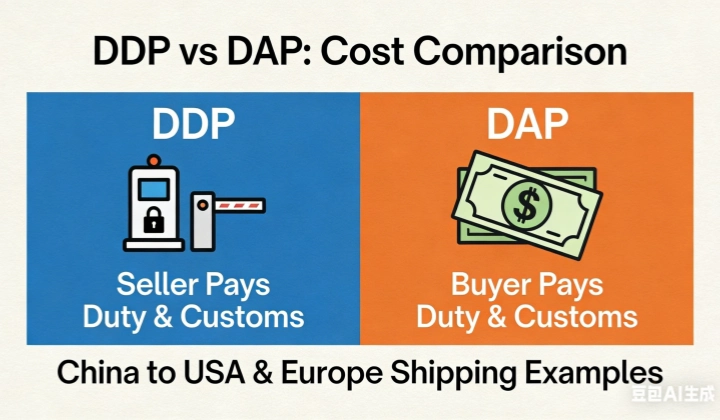
What Is DDP Shipping? Full Explanation, Costs & Responsibilities
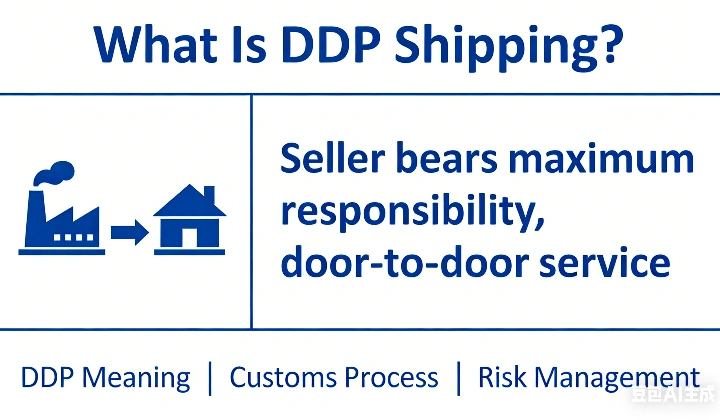
When it comes to international shipping, understanding Incoterms is crucial for avoiding disputes, controlling costs, and ensuring smooth transactions. Among the 11 Incoterms® 2020, DDP (Delivered Duty Paid) is one of the most comprehensive and often misunderstood terms—especially for sellers expanding into global markets. This guide dives deep into what is DDP shipping, clarifies DDP meaning, and provides a complete breakdown of its legal definition, obligations, customs process, costs, real-world cases, and risk management strategies. Whether you’re a seasoned exporter or new to cross-border trade, this guide will demystify delivered duty paid explained in practical, actionable terms.
1. DDP Legal Definition (Incoterms® 2020 Compliant)
First, let’s clarify the official DDP legal definition to avoid common misconceptions. Under Incoterms® 2020, Delivered Duty Paid (DDP) is a shipping term where the seller bears the maximum responsibility and all risks associated with transporting goods to the buyer’s named destination (e.g., the buyer’s warehouse, office, or FBA facility). The seller’s obligation only ends when the goods are made available to the buyer, ready for unloading—unloading is not a default responsibility of the seller unless explicitly agreed in the contract (labeled as "DDP Unloaded").
Legally, DDP requires the seller to handle every step of the shipping process, including export clearance, international transportation, import customs clearance, and payment of all duties, taxes (VAT/GST/sales tax), and local fees. The buyer’s only default obligation is to unload the goods upon arrival. It’s critical to note that DDP applies toall modes of transport (sea, air, road, rail) and is binding as long as both parties include it in their sales contract.
A key legal distinction: DDP is the only Incoterm where the seller acts as the Importer of Record (IOR) in the destination country. This means the seller is legally responsible for ensuring compliance with local customs laws, which can carry significant legal risks if not managed properly.
2. Seller Obligations Under DDP Shipping
Understanding seller obligations is essential for avoiding costly mistakes and ensuring compliance. Unlike other Incoterms (e.g., DAP, CIF), DDP places nearly all responsibilities on the seller. Below is a detailed breakdown of the seller’s core obligations:
- Export Clearance: Prepare and submit all required export documents (commercial invoice, packing list, certificate of origin, export license if applicable) to clear goods from the country of origin. The seller must also comply with export restrictions and sanctions (e.g., US OFAC, EU sanctions) to avoid shipment delays or seizures.
- International Transportation: Arrange and pay for all transportation costs to deliver the goods to the buyer’s named destination. This includes freight (sea/air/road), insurance, and any intermediate handling fees (e.g., transshipment costs).
- Import Customs Clearance: Act as the Importer of Record (IOR) in the destination country, submit import declarations, and ensure compliance with local customs regulations. This may require the seller to obtain a local tax ID (e.g., EU VAT number, US EIN) or register as a non-resident importer (NRI).
- Payment of Duties & Taxes: Cover all import duties, value-added tax (VAT), goods and services tax (GST), sales tax, and any other local fees (e.g., customs inspection fees, storage fees) associated with the shipment. These costs must be factored into the seller’s pricing to avoid profit erosion.
- Risk Mitigation: Bear all risks of loss or damage to the goods until they are delivered to the buyer’s destination. This includes risks from transportation delays, customs seizures, damage during transit, or non-compliance with local laws.
- Document Handover: Provide the buyer with all necessary documents (bill of lading, commercial invoice, customs clearance receipts, tax documents) to confirm delivery and facilitate any post-delivery processes (e.g., product registration).
- Note: The buyer’s only default obligation is to unload the goods. If the buyer requests the seller to handle unloading, the contract must explicitly state "DDP Unloaded"—otherwise, the seller is not legally required to provide unloading labor or equipment.
3. DDP Customs Process Flow (Step-by-Step)
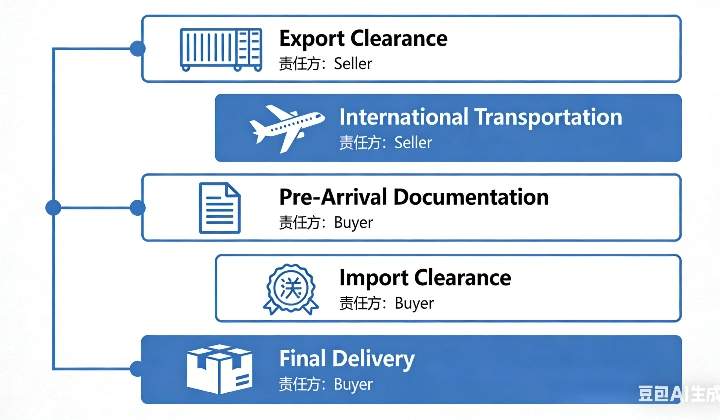
The customs process flow for DDP is more complex than other Incoterms because the seller is responsible for both export and import clearance. Below is a step-by-step breakdown of the typical DDP customs process, using a China-to-USA shipment as an example (aligned with the real case later in this guide):
- Step 1: Export Clearance (Origin Country – China)The seller prepares export documents: commercial invoice (with detailed product descriptions, HS codes, and value), packing list, certificate of origin (CO), and export license (if required for restricted goods).The seller submits documents to Chinese customs (via the China Customs E-Port system) and pays any export duties (if applicable).Customs inspects the goods (random or targeted) and clears them for export once compliance is confirmed.
- Step 2: International TransportationThe seller arranges freight (e.g., sea freight from Shanghai to Los Angeles) and purchases cargo insurance to cover loss or damage during transit.The goods are loaded onto the carrier (ship/airplane) and transported to the destination country (USA).
- Step 3: Pre-Arrival Documentation (Destination Country – USA)The seller (or their US customs broker) submits import documents to US Customs and Border Protection (CBP) in advance (typically 24–48 hours before arrival) to speed up clearance.Required documents: commercial invoice, bill of lading, packing list, certificate of origin, and any US-specific documents (e.g., FDA approval for food/medical products).
- Step 4: Import Clearance (USA)CBP reviews the documents and assesses duties and taxes based on the product’s HS code, value, and origin (e.g., China may be subject to additional tariffs under Section 301).The seller pays all applicable duties, US sales tax (varies by state), and CBP fees (e.g., merchandise processing fee).CBP may conduct a physical inspection of the goods (e.g., to verify product compliance or value). The seller bears the cost of inspection and any storage fees during delays.
- Step 5: Final Delivery to BuyerOnce cleared, the goods are transported to the buyer’s named destination (e.g., a warehouse in Chicago).The seller notifies the buyer of delivery, and the buyer unloads the goods (unless "DDP Unloaded" is agreed).The seller provides the buyer with all clearance documents and tax receipts for their records.
4. DDP Tax Calculation Example (2026 Rates)
One of the biggest challenges with DDP is accurately calculating taxes and duties, which directly impact profit margins. Below is a tax calculation example for a DDP shipment from China to Germany (EU), using 2026 tax rates and real-world HS codes to illustrate how costs add up:
Shipment Details: 500 units of wireless headphones, HS Code 8518.3000 (audio equipment), FOB value = $20,000, Freight cost = $1,500, Insurance cost = $300.
Key Calculations (Germany 2026):
- Customs Value (CV): FOB Value + Freight + Insurance = $20,000 + $1,500 + $300 = $21,800. (Customs value is used to calculate duties.)
- Import Duty: HS Code 8518.3000 has a duty rate of 3.7% in the EU (2026). Duty = CV × Duty Rate = $21,800 × 3.7% = $806.60.
- VAT (Value-Added Tax): EU VAT rate for electronics is 19% (Germany 2026). VAT is calculated on (Customs Value + Duty) = ($21,800 + $806.60) × 19% = $22,606.60 × 19% = $4,295.25.
- Additional Fees: Customs inspection fee = $150, Merchandise processing fee = $200.
- Total Tax & Duty Cost: $806.60 (Duty) + $4,295.25 (VAT) + $150 (Inspection) + $200 (Processing) = $5,451.85.
- Total DDP Cost for Seller: FOB Value + Freight + Insurance + Tax & Duty + Other Fees = $20,000 + $1,500 + $300 + $5,451.85 = $27,251.85.
- Critical Note: If the seller is not registered as a non-resident VAT entity in Germany, they cannot reclaim the $4,295.25 VAT, turning it into a permanent cost. This is why many sellers factor a "VAT buffer" into their DDP quotes or opt for non-resident VAT registration to recover these funds.
5. Real Case: China to USA DDP Shipment (2026)
To put DDP into practice, let’s walk through a real case: China to USA DDP shipment involving a Chinese electronics manufacturer (seller) and a US retail company (buyer). This case highlights common challenges, cost breakdowns, and lessons learned.
Case Background
Seller: Shenzhen-based electronics manufacturer (non-resident in the US, no US VAT/EIN registration).
Buyer: US retail chain (based in Texas, VAT-registered for sales tax purposes).
Shipment: 1,000 units of smartwatches, HS Code 8517.6200, FOB value = $50,000, Freight (sea) = $3,000, Insurance = $500.
Destination: Buyer’s warehouse in Dallas, Texas (DDP, no unloading agreed).
Challenges & Process
- Pre-Shipment: The seller initially underestimated US Section 301 tariffs (additional 7.5% on Chinese electronics in 2026) and failed to register as a non-resident importer (NRI) in the US. This led to delays in customs clearance and unexpected costs.
- Customs Clearance: Upon arrival in Los Angeles, CBP flagged the shipment for a physical inspection (random check). The seller incurred $800 in storage fees and $300 in inspection fees while waiting for clearance. Additionally, the seller had to pay Section 301 tariffs (7.5% on $53,500 customs value = $4,012.50) plus standard duty (2.5% = $1,337.50) and Texas sales tax (6.25% = $3,468.75).
- Delivery: After clearance, the goods were transported to Dallas, but the buyer refused to unload them, claiming the seller was responsible. The contract did not specify "DDP Unloaded," so the seller had to arrange and pay for unloading ($500) to avoid further delays.
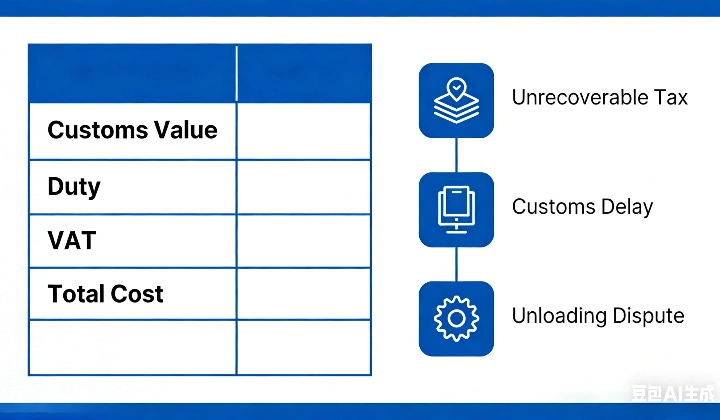
- Post-Delivery: The seller was unable to reclaim the $3,468.75 sales tax (no US NRI registration), resulting in a $3,468.75 loss. Total unexpected costs: $800 (storage) + $300 (inspection) + $500 (unloading) + $3,468.75 (unrecoverable sales tax) = $5,068.75.
Lessons Learned
- Always research and account for additional tariffs (e.g., Section 301) when quoting DDP to the US.
- Register as a non-resident importer (NRI) in the destination country to reclaim taxes (if applicable).
- Explicitly state unloading responsibilities in the contract (e.g., "DDP Unloaded" if the seller is to handle it).
- Work with a local customs broker in the destination country to navigate complex regulations and avoid delays.
6. DDP Risk Management Strategies
DDP carries significant risks for sellers—from unexpected tax costs to customs seizures and legal liability. Below are actionable risk management strategies to protect your business and margins:
a. Conduct Thorough Market & Regulatory Research
Before offering DDP, research the destination country’s customs laws, tax rates, and import restrictions. Key factors to check:
Applicable duties, VAT/GST/sales tax rates, and additional tariffs (e.g., Section 301, EU anti-dumping duties).IOR requirements (e.g., local tax ID, NRI registration) and documentation needs (e.g., certificate of origin, product compliance certificates).Customs inspection rates and common reasons for delays (e.g., incomplete documentation, product misclassification).
b. Secure Non-Resident Tax Registration (If Applicable)
For high-value shipments to countries like the EU, UK, or Canada, register as a non-resident VAT/GST entity to reclaim import taxes. This requires working with a local tax agent but can save 15–25% in unrecoverable tax costs.
c. Use a Reputable Local Customs Broker
A local customs broker in the destination country understands local regulations, can handle documentation errors, and expedite clearance. They can also help you avoid common pitfalls (e.g., HS code misclassification) that lead to seizures or fines.
d. Include Clear Contract Clauses
Protect yourself with detailed contract clauses:Explicitly state unloading responsibilities (e.g., "DDP Unloaded" or "Buyer responsible for unloading").Add a currency adjustment clause to mitigate exchange rate risk (taxes and duties are paid in local currency).Define liability for delays (e.g., who pays storage fees if customs clearance is delayed due to buyer error).Specify dispute resolution processes for customs-related issues.
e. Purchase Comprehensive Cargo Insurance
DDP requires the seller to bear all risk until delivery, so invest in cargo insurance that covers loss, damage, and delays. Look for policies that include coverage for customs seizures (due to non-compliance) and storage fees during delays.
f. Price DDP Quotes Strategically
Factor in all potential costs when quoting DDP:
Freight, insurance, and handling fees.Duties, taxes, and customs fees (add a 10–15% buffer for unexpected costs).Non-resident registration and tax agent fees.Potential storage, inspection, or unloading fees.
7. Conclusion
DDP shipping (Delivered Duty Paid) is a powerful tool for sellers looking to offer a hassle-free experience to international buyers—but it requires careful planning, compliance, and risk management. By understanding the legal definition, fulfilling seller obligations, navigating the customs process, accurately calculating taxes, learning from real cases, and implementing robust risk management strategies, you can leverage DDP to expand your global reach while protecting your margins. Whether you’re shipping from China to the USA or any other global market, this guide provides the foundation to master DDP shipping in 2026 and beyond.
Related Resources