DDP vs. Double Customs Clearance: What's the Real Difference?
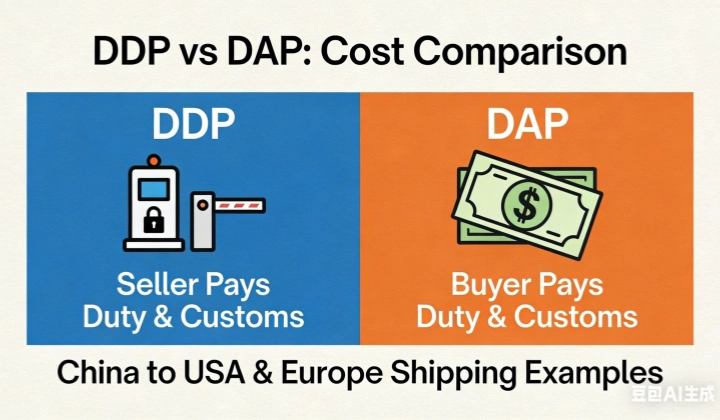
When importing goods from China, international buyers often come across two shipping terms: DDP (Delivered Duty Paid) and Double Customs Clearance with Taxes Included.
At first glance, they sound almost identical.
Both may offer door-to-door delivery, customs clearance, import duty handling, and final delivery to the buyer's warehouse.
But are they actually the same?
Not exactly. DDP is an internationally recognized trade term that defines the responsibilities of buyers and sellers. Double customs clearance with taxes included is a logistics service arrangement commonly offered by freight forwarders in China.
Although both can result in goods arriving at the buyer's destination without additional freight or customs payments, the underlying import procedures may be very different.
For businesses importing from China, understanding these differences is essential for managing customs compliance, controlling costs, and protecting long-term supply chain operations.
Learn more about our DDP Shipping Services for international commercial shipments.
1. What Is DDP Shipping?
DDP stands for Delivered Duty Paid, one of the 11 Incoterms® 2020 rules published by the International Chamber of Commerce (ICC — Incoterms® 2020).
Under DDP, the seller assumes responsibility for arranging transportation and completing the required export and import customs formalities, including paying applicable import duties and taxes, until the goods are delivered to the agreed destination.
A typical DDP shipment from China may involve:
- Pickup and inland transportation in China
- Export customs clearance
- International air freight or ocean freight
- Destination customs clearance
- Applicable import duties, VAT, and other taxes
- Inland transportation to the agreed destination
- Final delivery to the buyer's warehouse or facility
For example, imagine a US company purchasing $100,000 worth of industrial equipment from a Chinese manufacturer under DDP terms.
The Chinese seller is responsible for arranging transportation, handling the required customs procedures, paying applicable import duties and taxes, and delivering the shipment to the agreed US destination.
The buyer generally does not need to separately arrange or pay for those services covered by the DDP agreement.
However, there is an important distinction.
DDP defines contractual responsibilities. It does not automatically determine who can legally act as the Importer of Record in the destination country.
Import procedures must still comply with local customs regulations, importer registration requirements, and applicable tax laws.
Under standard DDP terms, the goods are delivered ready for unloading. The buyer normally handles unloading unless the parties have agreed otherwise.
2. What Is Double Customs Clearance with Taxes Included?
Double customs clearance with taxes included is a service commonly marketed by freight forwarders in China.
You may also encounter descriptions such as:
- Double customs clearance and tax-inclusive shipping
- Customs-cleared, duty-paid door-to-door shipping
- Tax-included freight forwarding
- All-inclusive shipping from China
In Chinese logistics terminology, this service is often called Shuang Qing Bao Shui (双清包税).
It generally refers to a shipping arrangement in which a logistics provider coordinates export clearance in China, import clearance at the destination, applicable tax handling, international transportation, and final delivery.
For importers, the main appeal is convenience.
Instead of managing transportation, customs brokers, and delivery providers separately, customers receive a consolidated logistics quotation.
This approach is frequently marketed for e-commerce shipments, overseas warehouse replenishment, and consolidated commercial cargo.
However, there is a critical detail that importers should understand.
Double customs clearance with taxes included is not an official Incoterms® rule, and the term does not establish a globally standardized customs procedure.
Different freight forwarders may use different import arrangements.
Some may arrange clearance through the buyer's registered importing entity. Others may work with their own authorized importing entity or a third-party Importer of Record.
These arrangements are not automatically illegal.
Their compliance depends on the destination country's regulations, the legal status of the importer, the accuracy of customs declarations, and the supporting commercial documentation.
That is why importers should never assume that an all-inclusive shipping quote automatically guarantees compliant import clearance.
3. DDP vs. Double Customs Clearance: Key Differences
The biggest difference is not necessarily the final delivery experience.
It is the distinction between contractual trade responsibilities and the actual customs clearance arrangement.
Difference 1: Trade Term vs. Logistics Service
DDP is an internationally recognized Incoterms® rule.
It defines how transportation responsibilities, customs obligations, costs, and risks are allocated between the seller and buyer.
Double customs clearance with taxes included describes a package of logistics services.
It does not independently establish the contractual obligations of the seller and buyer.
These two concepts can overlap.
For example, a seller operating under a DDP sales contract may appoint a freight forwarder offering tax-inclusive customs clearance services to handle the shipment.
Therefore, DDP and double customs clearance are not necessarily competing shipping methods.
Difference 2: Who Is the Importer of Record?
This is one of the most important questions for international buyers.
The Importer of Record (IOR) is the party recognized under the applicable customs framework as responsible for import entry and associated legal obligations.
Depending on the country, these responsibilities may include accurate customs declarations, tariff classification, customs valuation, regulatory compliance, and payment of applicable duties and taxes.
Under a DDP contract, the seller is responsible for arranging import clearance.
However, this does not automatically mean the buyer must be listed as the Importer of Record.
The actual importer must be determined according to local law and the agreed commercial arrangement.
Similarly, a double customs clearance service may use an authorized third-party importer.
The key questions are:
- Who is officially identified as the importer?
- Is that entity legally permitted to import the goods?
- Who is responsible for the customs declaration?
- Can the relevant import documentation be verified?
- Does the arrangement support the buyer's intended commercial use of the goods?
For businesses importing inventory for resale, these questions can be just as important as the freight rate.
Difference 3: Customs Declaration Accuracy
Regardless of whether a shipment is described as DDP or tax-inclusive shipping, customs declarations must comply with the applicable laws.
Consider a shipment of ceramic products valued at $100,000.
The customs declaration should accurately reflect the goods and their relevant commercial details, including:
- Product description
- Applicable HS classification
- Customs value determined under local valuation rules
- Quantity and country of origin
- Applicable duties, taxes, and trade measures
In some cases, unusually low shipping quotations may raise questions about how import duties and customs charges are being calculated.
For example, potential warning signs include inaccurate product descriptions, unsupported customs values, incorrect tariff classifications, or missing import records.
These practices can create serious compliance risks.
However, such risks are not exclusive to double customs clearance services.
A shipment labeled DDP can also involve improper customs procedures if the underlying declaration is inaccurate.
A shipping label does not determine customs compliance. The actual import process does.
4. Why Customs Documentation Matters for Importers
For international buyers, receiving the goods is only one part of a successful import transaction.
The ability to demonstrate a legitimate commercial and import history can be equally important.
Imagine a European distributor importing products from China through a freight forwarder offering all-inclusive shipping.
The shipment arrives at the distributor's warehouse without any apparent problems.
Several months later, the company needs supporting documentation for an accounting review, tax assessment, or customs inquiry.
If the importer cannot obtain the necessary records, it may face additional administrative difficulties or compliance questions.
Depending on the transaction and jurisdiction, relevant documentation may include:
- Commercial invoices and purchase agreements
- Packing lists and transport documents
- Customs entry or import declaration records
- Evidence of applicable import duty and tax payments
- Documentation establishing a lawful purchase or transfer of the goods
Importantly, a buyer does not necessarily need to be the Importer of Record to have a legitimate commercial source for its inventory.
Goods can be legally imported by an authorized third party and subsequently sold or supplied through properly documented transactions.
However, the buyer should understand the arrangement and maintain the records required for its own business activities.
For companies seeking to recover import VAT, additional local tax rules may apply.
The right to deduct or reclaim import VAT cannot be assumed simply because shipping was advertised as DDP or tax-inclusive.
5. Why Are Some Tax-Included Shipping Quotes Much Cheaper?
When comparing shipping quotations from China, importers may notice substantial price differences.
One freight forwarder may provide a DDP quotation that is significantly higher than another provider's all-inclusive shipping rate.
Does that automatically mean the cheaper service is non-compliant?
No.
Legitimate price differences can result from transportation contracts, shipment consolidation, carrier capacity, customs handling efficiency, delivery networks, and differences in the services included.
However, an unusually low quotation deserves closer examination.
Importers should ask:
Are all applicable import duties and taxes included?
Does the quotation cover the correct tariff treatment for the actual goods?
Who will act as the Importer of Record?
Is the importing entity properly authorized under local regulations?
Will customs documentation be available?
Can the service provider explain which import records and supporting documents can be supplied?
What happens if customs authorities request additional information?
Who will coordinate the response, and who will bear any additional costs under the agreed contract?
Are there any exclusions or additional charges?
Could destination handling, inspections, storage, tax adjustments, or other fees arise?
A transparent freight forwarder should be able to explain the structure of its service and the responsibilities of the parties involved.
For long-term importers, the lowest initial quotation is not always the most cost-effective solution.
6. DDP vs. Double Customs Clearance: Comparison Table
| Factor | DDP Shipping | Double Customs Clearance with Taxes Included |
|---|---|---|
| Definition | Official Incoterms® trade rule | Commercial logistics service description |
| Main purpose | Defines seller and buyer obligations | Packages transportation, clearance, and tax handling |
| International standard | Governed by Incoterms® 2020 | No single globally recognized definition |
| Import clearance | Seller is contractually responsible for arranging it | Depends on the logistics arrangement |
| Importer of Record | Determined under destination-country law | May be buyer, provider, or authorized third party, subject to local law |
| Import duties and taxes | Generally borne by seller under DDP | Depends on the quoted service scope |
| Customs documentation | Must satisfy applicable legal requirements | Depends on the actual import process and agreed documentation |
| Compliance | Depends on lawful execution | Depends on lawful execution |
| Door-to-door delivery | Usually included up to the named destination | Commonly included, subject to quotation |
Key takeaway: DDP establishes contractual responsibility. Double customs clearance describes a logistics service. Neither term alone guarantees that the import process is compliant.
7. Which Shipping Option Is Better for Your Business?
The right solution depends on your business model, destination country, import capabilities, and the type of goods being shipped.
For established importers
If your company already has the necessary importer registrations, customs arrangements, and local tax capabilities, you may prefer a structure that provides greater visibility and control over import clearance.
Depending on your agreement with the supplier, DAP or another suitable Incoterms® rule may be worth considering.
For e-commerce sellers and overseas warehouse operators
If you regularly replenish inventory from China, an integrated shipping solution can simplify transportation and delivery coordination.
However, you should verify the Importer of Record arrangement, documentation availability, and any VAT or customs requirements relevant to your business.
For businesses requesting DDP shipping
DDP can be convenient when the seller is legally and operationally capable of arranging import clearance in the destination country.
But DDP may not be suitable in every jurisdiction.
Some countries impose restrictions or additional requirements on foreign entities seeking to act as importers.
If the seller cannot lawfully fulfill its import clearance obligations, an alternative such as DAP may be more appropriate.
The best solution is not simply the one with the fewest steps for the buyer.
It is the one that combines predictable costs, appropriate responsibilities, reliable delivery, and compliant customs procedures.
8. Five Questions to Ask Before Booking Shipping from China
Before accepting a DDP or tax-inclusive freight quotation, ask your logistics provider these five questions.
1. Who will be the Importer of Record?
Confirm which entity will be responsible for the import entry and whether the arrangement complies with local regulations.
2. How will my goods be declared?
Verify the product description, HS classification, customs valuation, origin, and other relevant declaration details.
3. What duties and taxes are included?
Ask for a clear explanation of the applicable tax treatment and any exclusions from the quotation.
4. Which customs documents can I receive?
Clarify what records will be available to support your accounting, compliance, and inventory management requirements.
5. What happens if customs clearance is delayed or challenged?
Understand the responsibilities, communication process, and potential additional costs before the shipment begins.
These questions can help identify potential issues before the goods leave China.
9. BSI Global Logistics: Beyond Delivery, Toward More Transparent Shipping
At BSI Global Logistics, we believe reliable international freight forwarding is about more than moving cargo from one country to another.
It is about helping businesses build transparent, dependable, and sustainable global supply chains.
For companies importing commercial goods from China, understanding customs responsibilities and destination-country requirements is an important part of selecting the right logistics solution.
Whether a shipment moves under DDP, DAP, FOB, CIF, or another agreed trade term, the transportation and customs arrangements should reflect the actual transaction, cargo characteristics, and applicable regulations.
We emphasize accurate shipment information, transparent communication, and compliance-conscious logistics planning.
Our goal is to help customers make informed shipping decisions, understand the responsibilities involved, and reduce avoidable uncertainties in international transportation.
Because successful international shipping is not just about getting goods delivered. It is about knowing how they are delivered.
Frequently Asked Questions
Is DDP the same as double customs clearance with taxes included?
No. DDP is an official Incoterms® trade rule that allocates responsibilities between buyers and sellers. Double customs clearance with taxes included is a logistics service description. They can produce similar delivery results but are not the same concept.
Is double customs clearance with taxes included legal?
It can be legal if the import arrangement complies with destination-country regulations, the importer is properly authorized, customs declarations are accurate, and applicable duties and taxes are handled lawfully.
Who is the Importer of Record under DDP shipping?
The Importer of Record depends on the destination country's laws and the actual import arrangement. DDP makes the seller responsible for arranging import clearance, but it does not automatically require the buyer to be the named importer.
Does DDP shipping include import duties and taxes?
Under standard DDP Incoterms® 2020 obligations, the seller is responsible for applicable import duties and taxes. The contract should clearly identify the named destination and any expressly agreed variations.
Can I reclaim import VAT on a DDP shipment?
Not automatically. Import VAT recovery depends on local tax laws, the importing entity, the nature of the transaction, and the available supporting documentation. Importers should confirm eligibility with a qualified local tax adviser.
Is DDP shipping always the best option for importing from China?
No. DDP can be convenient, but it may not be appropriate where the seller cannot legally or practically arrange import clearance. DAP or another trade term may provide a better allocation of responsibilities.
What is the biggest risk of choosing a cheap tax-included shipping service?
The main concern is insufficient transparency about the importer, customs declarations, tax treatment, or supporting documentation. A low price alone does not indicate non-compliance, but unclear import arrangements deserve careful review.
Final Thoughts: Look Beyond the Shipping Label
DDP and double customs clearance with taxes included may look similar from a delivery perspective, but they serve different purposes.
DDP defines the responsibilities of buyers and sellers under an internationally recognized trade rule.
Double customs clearance with taxes included describes a logistics service whose actual procedures depend on the provider and destination country.
For international importers, the most important considerations are not simply the quoted price or the shipping label.
They are the accuracy of customs declarations, the legitimacy of the importing entity, the handling of duties and taxes, and the availability of appropriate documentation.
Before choosing a shipping solution, make sure you understand not only what is included in the price, but also how your goods will be imported.
Planning a commercial shipment from China?
Contact BSI Global Logistics to discuss your cargo, destination requirements, and suitable international freight solutions.
Related Resources