China’s Foreign Trade Reached RMB 16.23 Trillion in the First Four Months of 2026, Up 14.9%
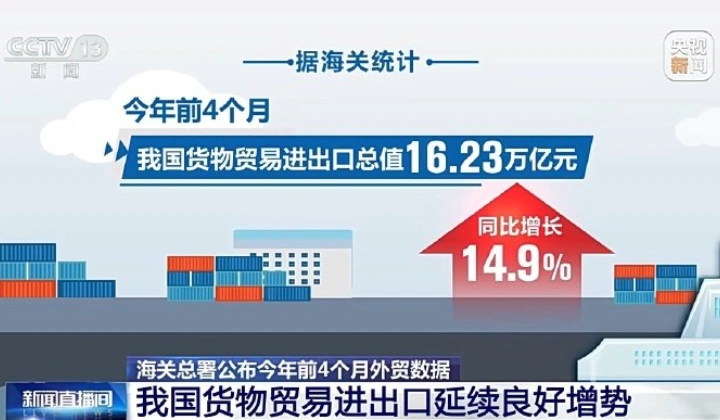
China’s foreign trade continued to show strong momentum in early 2026. According to the latest data released by China Customs, the total value of China’s goods trade reached RMB 16.23 trillion in the first four months of 2026, representing a year-on-year increase of 14.9%.
Among the total:
- Exports reached RMB 9.33 trillion, up 11.3%
- Imports reached RMB 6.9 trillion, up 20%
In April alone:
- Total imports and exports reached RMB 4.38 trillion, up 14.2%
- Exports totaled RMB 2.48 trillion, up 9.8%
- Imports totaled RMB 1.9 trillion, up 20.6%
The latest trade figures highlight the resilience of China’s manufacturing sector, export supply chains, and global logistics network despite ongoing shifts in international trade patterns.
China’s Foreign Trade Continues to Expand in 2026
The latest customs data shows that China’s international trade growth remains stable across multiple sectors and regions.
Several key trends are shaping global supply chains in 2026:
- ASEAN remains China’s largest trading partner
- Belt and Road markets continue to grow rapidly
- Bonded logistics and processing trade are expanding
- US-China trade continues to decline
- Electromechanical products remain China’s top export category
For international logistics companies, freight forwarders, importers, and cross-border eCommerce sellers, these developments signal continued growth opportunities across Asia, the Middle East, Latin America, and emerging markets.
Bonded Logistics Recorded the Fastest Growth
From January to April 2026, China’s trade structure showed significant changes.
| Trade Type | Total Value | YoY Growth |
|---|---|---|
| General Trade | RMB 9.82 trillion | +8.5% |
| Processing Trade | RMB 3.08 trillion | +21.3% |
| Bonded Logistics | RMB 2.81 trillion | +38.7% |
Bonded logistics recorded the strongest growth among all trade categories.
This trend reflects the rapid expansion of:
- Cross-border eCommerce logistics
- Overseas warehouse operations
- Re-export and transshipment trade
- Regional distribution hubs in Southeast Asia
As global supply chains become more flexible, bonded warehousing and multi-country fulfillment solutions are becoming increasingly important for international businesses.
ASEAN Remains China’s Largest Trading Partner
China’s trade with ASEAN countries continued to grow strongly in 2026.
| Trading Partner | Trade Value | YoY Growth |
|---|---|---|
| ASEAN | RMB 2.75 trillion | +15.7% |
| European Union | RMB 2.01 trillion | +13.2% |
| United States | RMB 1.25 trillion | -12.9% |
ASEAN maintained its position as China’s largest trading partner.
The continued growth reflects several long-term trends:
- Manufacturing shifts from China to Southeast Asia
- Deepening regional supply chain integration
- RCEP-driven trade expansion
- Increasing investments in Vietnam, Thailand, Malaysia, and Indonesia
As a result, shipping demand between China and Southeast Asia is expected to remain strong throughout 2026.
Related Shipping Routes
- Shipping from China to Vietnam
- Shipping from China to Thailand
- Shipping from China to Malaysia
- Shipping from China to Indonesia
Belt and Road Trade Continues to Grow
During the same period, China’s total trade with Belt and Road partner countries reached RMB 8.28 trillion, increasing by 13.5% year-on-year.
The growth highlights rising demand across:
- The Middle East
- Central Asia
- Africa
- Latin America
Chinese exports of machinery, industrial equipment, electronics, and construction materials continue to expand in these markets.
For the logistics industry, this means growing opportunities in:
- Air freight
- Sea freight
- Project cargo logistics
- DDP shipping solutions
- Overseas warehousing
Related Shipping Routes
- Shipping from China to Saudi Arabia
- Shipping from China to UAE
- Shipping from China to Egypt
- Shipping from China to Brazil
Private Enterprises Remain the Main Driver of China’s Foreign Trade
From January to April 2026:
| Enterprise Type | Trade Value | YoY Growth |
|---|---|---|
| Private Enterprises | RMB 9.31 trillion | +15.9% |
| Foreign-Invested Enterprises | RMB 4.72 trillion | +15.4% |
| State-Owned Enterprises | RMB 2.16 trillion | +9.8% |
Private companies continued to account for the largest share of China’s foreign trade.
This reflects the ongoing expansion of:
- Cross-border eCommerce sellers
- SME exporters
- Flexible manufacturing supply chains
- International B2B trade
As competition intensifies, businesses are increasingly prioritizing:
- Faster shipping
- DDP logistics services
- Customs clearance efficiency
- Overseas warehouse fulfillment
- Last-mile delivery reliability
Electromechanical Products Remain China’s Largest Export Category
China’s export structure continues to shift toward higher-value products.
Export Highlights
| Product Category | Value |
|---|---|
| Electromechanical Products | RMB 5.92 trillion (+17.6%) |
| Labor-Intensive Products | RMB 1.26 trillion (-2.6%) |
| Agricultural Products | RMB 240.15 billion (+2%) |
Major export categories include:
- Consumer electronics
- Industrial machinery
- Energy storage equipment
- Automotive components
- Smart devices
- Renewable energy products
The growth in high-value cargo is also driving increased demand for:
- Air freight services
- Lithium battery shipping
- Sensitive cargo logistics
- Fast customs clearance solutions
Related Logistics Guides
- Air Freight from China to USA
- Shipping Lithium Batteries from China
- Shipping from China to Mexico
BSI Global Logistics Analysis: Global Supply Chains Are Being Reshaped in 2026
The latest trade data clearly shows that global supply chains are continuing to evolve.
1. Southeast Asia Is Becoming More Important
ASEAN’s continued growth reflects the acceleration of regional manufacturing and supply chain diversification.
2. US-China Trade Continues to Shift
Trade between China and the United States continues to decline, pushing companies to explore alternative sourcing and market strategies.
3. Emerging Markets Are Driving New Growth
The Middle East, Africa, Latin America, and Belt and Road countries are becoming increasingly important for exporters.
4. Bonded Logistics and Cross-Border eCommerce Continue to Expand
Overseas warehouses, bonded warehouses, and regional distribution centers are playing a larger role in global trade.
5. High-Value Manufacturing Remains Strong
China’s exports are increasingly focused on advanced manufacturing, electronics, and industrial technology products.
Which Shipping Routes Will See the Fastest Growth in 2026?
Based on current trade trends, the following trade lanes are expected to remain highly active throughout 2026:
- China to Southeast Asia
- China to the Middle East
- China to Mexico
- China to Brazil
- China to Africa
- China to Europe
Recommended Shipping Routes
- Shipping from China to Singapore
- Shipping from China to Cambodia
- Shipping from China to Laos
- Shipping from China to Myanmar
Conclusion
China’s foreign trade maintained strong growth during the first four months of 2026, demonstrating the resilience of China’s manufacturing sector and global supply chain capabilities.
For importers, exporters, eCommerce sellers, and global manufacturers, the current market environment highlights the importance of:
- Diversifying supply chains
- Expanding into emerging markets
- Improving shipping efficiency
- Building overseas warehouse networks
- Securing reliable international logistics partners
As global trade patterns continue to evolve, BSI Global Logistics will continue to provide reliable international freight forwarding, air freight, sea freight, DDP shipping, customs clearance, and overseas warehouse solutions for businesses worldwide.
Related Resources